 UK Based Pharmacy
  Discreet Packaging
  Next Day Delivery


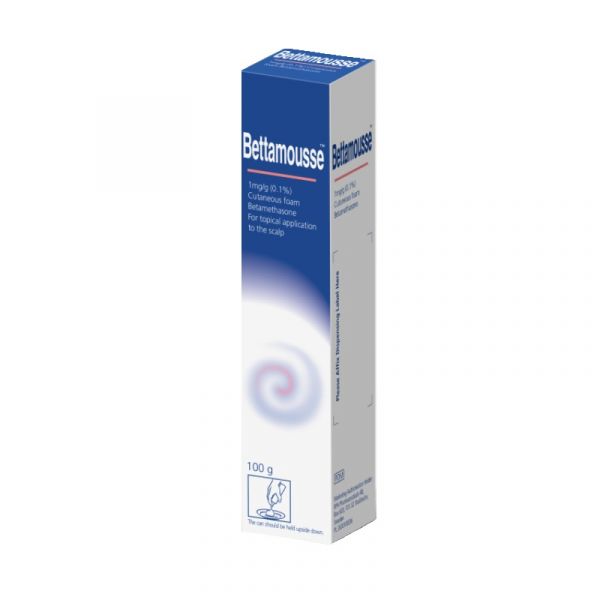
Bettamousse 0.1% Cutaneous Foam
£28.99
- Corticosteroid foam that helps reduce redness, itching and swelling.
- Spreads and absorbs easily, without leaving residue.
- Short-term, fast-acting foam to relieve symptoms.
Only 4 left in stock

Discreet Packaging

UK Based
-
What is Bettamousse used for?
Bettamousse is a prescription-only treatment, containing betamethasone valerate, that’s used on the scalp to help relieve inflammatory skin conditions like eczema, psoriasis and seborrhoeic dermatitis. It comes as a light foam and is designed to spread easily, absorb well into the skin, and work effectively on hairy areas like the scalp without leaving a greasy residue. Bettamousse helps reduce redness, itching and swelling by blocking inflammatory chemicals in the skin, and is often prescribed when milder corticosteroids have not worked. It is intended for short‑term use only and should be stopped if there is no improvement after 7 days.How to use Bettamousse
Bettamousse can be applied up to twice a day, though it’s only recommended to use it once a day if your condition has improved. Before applying Bettamousse, you should read the directions for use in the patient information leaflet. To apply a scalp foam:- Wash and dry your hands.
- Massage a small amount of foam into your scalp (the amount of mousse should be no more than golf-ball sized).
- Allow your scalp to dry naturally, without using a hair dryer.
- Wash your hands afterwards.
- skin irritation, like burning, itching, or stinging on your scalp
- skin changes, like thinning or dryness
- folliculitis (inflammation of the hair follicles)
Can Bettamousse be used for hair loss?
No. While Bettamousse helps relieve symptoms of conditions like psoriasis, which can occasionally cause temporary hair loss, it is not a licensed hair loss treatment in the UK.Warnings
Bettamousse is only intended for short-term use. If applying twice daily, it should not be continued past 7 days unless a doctor has advised otherwise. If at any point while using Bettamousse you notice your symptoms are getting worse, you should contact a healthcare professional. To make sure Bettamousse is right for you, inform your doctor or pharmacist if you:- have ever had an allergic to betamethasone or any other medicine
- are breastfeeding
- have impetigo, acne, rosacea or a type of psoriasis called ‘pustular psoriasis’
- have a skin infection
- have broken skin, or skin that is itchy but not inflamed or red
Storage information
Keep the canister upright, and store below 25°C in a cool, dry area out of the reach of children. Bettamousse should not be refrigerated or frozen, nor should it be kept in direct sunlight. Protect from heat, as the foam is highly flammable. As it is pressurised, the can should not be pierced, even when empty.Alternative products
If you’re looking for treatments to help with skin conditions in your scalp, there are other topical corticosteroids that come in different forms like creams, ointments and lotions. Branded options include Betnovate.Frequently asked questions Bettamousse
Where should you not apply Bettamousse?
When using Bettamousse you should avoid applying it to:- face
- eyes/eyelids
- genital/rectal areas
- armpits
- broken skin
- scalp (if you have acne, rosacea, or perioral dermatitis)
How often should I use Bettamousse?
Bettamousse is designed as a short-term, fast-acting treatment. It should be applied twice daily for 7 days. You should not take the treatment for any longer than this.What happens if you use betamethasone for too long?
Using betamethasone continuously for a long time can allow small amounts of the medicine to enter your bloodstream. In rare cases, this may lead to serious side effects, including problems with the adrenal glands, raised blood sugar levels, or changes to your eyesight.Sources
- How and when to use betamethasone for skin (2023). NHS. [Accessed 14 April 2026]
- Common questions about betamethasone for skin (2023). NHS. [Accessed 14 April 2026]
- Side effects of betamethasone for skin (2023). NHS. [Accessed 15 April 2026]